Letter One
Seek to Integrate
Seek to Integrate
Dear student,
Yesterday, after class, you approached and asked if there were resources on how to navigate the field of psychology as a practicing Latter-day Saint. You expressed some fear that your faith would not be valued by your graduate instructors, that your belief in Christ would be sidelined as a counselor, and that your support for Church teachings on (for example) marriage and family might put you in some jeopardy.
I told you that I had some resources that I could send to you and then we could talk about them some more after you had a chance to look them over. That was not entirely honest. I already knew that resources for Latter-day Saint psychologists—specifically, how to navigate the discipline without losing faith—are scarce, and that there was not much I would be able to send you. A few things, yes. But not enough.
However, I have many things to say on the matter—much more than I can say in a single letter! I was stalling because I wanted to gather and organize my thoughts so that I didn’t drown you with a firehose. So, I decided to write you a series of letters. I hope these letters equip you with some conceptual tools, vocabulary, and inspiration as you leave our program and face the rigors of graduate school.
As you prepare for the next phase of your education, it can be helpful to think of yourself as an immigrant moving into the professional and academic world. Your faith can be compared to your culture of origin (or heritage culture), and the world of psychology can be compared to the culture of destination (or host culture). And like any immigrant, you will need to navigate between two languages and cultures—cultures that will inevitably clash at times (or at least produce tension).
According to psychologist John Berry (1997), people who are navigating two cultures can adopt different acculturation strategies. Acculturation is a term we use to refer to the ways people adapt when they come into sustained contact with a culture that differs from their own—that is, how much they keep of their original culture, how much of the new culture they adopt, and how they blend (or choose not to blend) the two. Berry describes four acculturation strategies: assimilation, separation, integration, and marginalization.
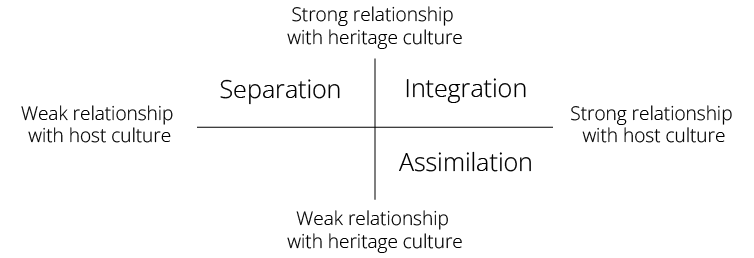
To illustrate what each of these looks like, let’s imagine an immigrant from Shanghai who moves to New York City. We’ll call him Wei Chen. If he chooses to assimilate into American culture, he might adopt an Americanized name like “Wayne,” opt to speak only English while at work, and distance himself from Chinese values and traditions. He might come to see his Chinese heritage as inferior to his new American identity and values.
If you assimilate into the culture of psychology, this means that you allow the values and norms of the profession to reshape you, your values, and your aspirations. As your religious upbringing bumps against the culture of the social sciences, you will notice inevitable fault lines—and it is often easier to embrace the norms, values, and traditions of the host culture (psychology) than carefully work through the tensions and conflicts. Over time, your native language of faith can become dulled by lack of practice, or it can start to seem foreign or old-fashioned compared to the now-familiar jargon of psychology.
I believe that Elder Neal A. Maxwell (1976) warned against assimilating to the secular culture of psychology when he invited Latter-day Saint social scientists to “become more of a link and bridge between revealed truth and the world of scholarship” (p. 589). He cautioned against “assuming a posture in which [Latter-day Saint] behavioral scientists are, at every point, indistinguishable from those whose approach is purely secular” (p. 590). You can’t be a shining light if you’re really just a mirror reflecting back whatever image is cast your way.
In other words, as an immigrant into the professional world, you should keep your culture of origin (your faith) as a core part of your identity. It should shape not just your personal life, but your intellectual and professional life as well. Christian scholar S. D. Gaede (1985) captured this idea with clarity when he wrote:
I am a Christian. This is a reality of no small importance to me. It has implications for my thoughts, my actions, my entire life. Scholarship is a part of my life. … In my opinion, I am just as obligated to be concerned with a Christian perspective in my scholarly pursuits as I am in matters pertaining to ethics, family life, or whatever. The point, of course, is that Christians should allow their Christianity to permeate their entire lives, and not just preselected portions of it. (p. 21)
Elder Jeffrey R. Holland (2012) put it maybe even more forcefully when he said, “Lesson number one for the establishment of Zion in the 21st century: You never ‘check your religion at the door.’ Not ever.” In fact, he said, such discipleship “is not discipleship at all.” We should stand as witnesses of God at all times and in all places—including in our professional work. Even if you maintain your faith in every other part of life—attending church, keeping covenants, and living as a practicing Latter-day Saint—if it makes no difference in your professional work, then you have assimilated in precisely the arena where the cultural contact is most intense.
Professional assimilation is tempting because it can bring you more credibility in your chosen field. You will certainly look less weird to others in the field if you hide or downplay your faith. However, Elder Maxwell (1976) taught that bridge-building requires “forsaking the easy praise of the world that comes from following the fashionable. … We must not be disturbed if we are unfashionable in terms of the trends of the time” (p. 591). He continued, “We must also avoid being conformed to the world” (p. 597). Doing this right will make you a bit eccentric, so be prepared for that.
In a different talk to Latter-day Saint psychologists, Elder Maxwell (1979) warned that keeping faith central to our professional identity will seldom be easy and will likely entail some difficult consequences. He taught:
Because you believe in these ultimate things and apply them in appropriate ways to your efforts to help others, doing this will put you at variance with colleagues who have other value systems and other priorities. Latter-day Saint professionals in a variety of fields will come to know what it means to bear “the shame of the world” and yet to despise it. (p. 5)
Further, if you fully assimilate in your profession, you’ll discover it’s rare to completely quarantine your personal faith from the effects of it. It is easy—seductively tempting—to gradually reframe your moral priorities through the secular lens of your professional training. Doing so can make you feel more educated, more informed, and more sophisticated than your peers in the pews. Even if you retain superficial aspects of your faith, the heart of your faith—your moral paradigm—can still be transformed.
We also risk importing cultural practices into our faith that might be contrary to the teachings of Christ. For an extreme example, I know of Latter-day Saint therapists who occasionally used pornography as part of their therapeutic toolbelt (because doing so is considered normal in their therapeutic subculture). They eventually started to chafe against spiritual warnings against pornography from Church leaders. Their professional assimilation ended up influencing their spiritual worldview. Elder Maxwell (1976) offered this insight:
While we may not now know fully how to construct all these bridges of which I have been speaking, we know now that some bridges simply cannot be built, however much some secular scholars struggle to do so. For instance, we may not yet know the best form of therapy in every case, but we can know that certain forms of therapy are clearly inappropriate for us as Latter-day Saints. (p. 590)
I know of other Latter-day Saint therapists who specialized in sex therapy (I have no qualms about that, in and of itself). But since it is normal for sex therapists to set aside moral considerations (outside of consent) and to let clients set their own therapeutic goals, they began to guide some of their clients through reservations about engaging in polyamorous relationships. Eventually, they abandoned their own reservations about polyamory and began to agitate against Church teachings on chastity. Their professional assimilation ultimately undermined their own covenant-keeping.
Those examples are extreme, but I have seen Latter-day Saint practitioners undergo similar but subtler transformations in their views on divorce, abortion, euthanasia, gender, the purpose of marriage, and even the role of prophets and continuing revelation. Sometimes the shift happens gradually, almost imperceptibly, as their professional norms are treated as the default lens for interpreting every moral question. Over time, their spiritual inheritance becomes mere window dressing.
This kind of quiet assimilation can amount to undercover conversion—a shifting of allegiance from one moral tradition to another. Conversion involves adopting a new identity, a new community, and a new set of values. When we begin to see ourselves primarily as psychologists—professionals who only happen to be Latter-day Saints—we risk adopting the discipline as our true community, the values of our chosen therapeutic subculture as our guiding moral framework, and our professional identity as our defining identity.
As we noted earlier, though, assimilation isn’t the only option when encountering a new culture. Let’s return to Berry’s model and our immigrant, Wei Chen. Instead of assimilating, Wei could choose separation as a strategy. To avoid cultural contamination, he might avoid engagement with the host culture except where circumstances demand it—he might conduct business almost exclusively in Mandarin and maintain a social circle of fellow Chinese immigrants. Because of your concerns about preserving your faith, you might find this strategy tempting as well.
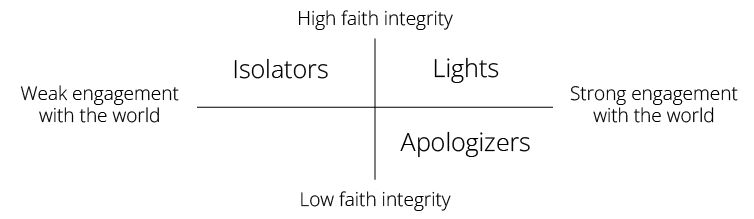
In a commencement address at Brigham Young University, Elder Clark G. Gilbert (2025) shared a chart with two axes: the vertical axis represented our integrity to our faith, and the horizontal axis represented our engagement with the world. Those in the bottom right corner—with low faith integrity but high engagement with the world—are what Elder Gilbert referred to as apologizers. This is the assimilation strategy I just described. Those in the top left corner—with high faith integrity but low engagement with the world—are what Elder Gilbert described as isolators. He explained:
Some of you will face pressures to seclude yourself in the forest of isolation. Others will engage wonderfully with the world, but will be tempted to apologize, and back away from the very faith that helped define who you are.
Elder Gilbert urged graduates (like you) to engage with the world but also to maintain their convictions with courage. To translate this into Berry’s terms, Elder Gilbert urged graduates to avoid assimilating (the apologizers) or separating (the isolators).
Direct engagement with the discipline can protect you from sloppy scholarship. When you present at academic conferences and seek feedback from those who disagree with you, you expose yourself to the refining critique that helps you articulate your perspectives and clarify your values. Of course, it is true that faith-based perspectives are often hypocritically subjected to more scrutiny—but do not be afraid of that heightened scrutiny. It can help you to relentlessly pursue high quality in your work.
Without regular engagement with the discipline, we can fall into a sloppiness that is masked by perceived “righteousness” in being different from the world. Interestingly, one of your peers recently shared this story with me:
I was in therapy to help treat my obsessive-compulsive disorder for many years. … In 2021 my obsessive-compulsive disorder started to interfere with my daily life again. It was crippling at times. So, I decided to seek out a therapist here in Rexburg. …
The first time I met him, he asked about my religious beliefs and offered me a priesthood blessing. He said it would help my therapeutic journey and open me up to healing. … I was desperate for help and he had over thirty years of experience, and I really wanted to trust a professional.
One day while discussing some very deep and personal stuff regarding my obsessive-compulsive disorder—behaviors that another therapist might have understood to be a form of scrupulosity—he told me that I should instead “just be OCD for Jesus!” Those were his exact words to me. … So, I stood up and walked out.
While ineffective and harmful therapy is found across the spectrum, it is possible that—in his zeal to maintain a religious perspective in his work—this therapist neglected scholarship surrounding scrupulosity (or dismissed it offhand simply because it was from a secular source). Rather than carefully refining his approach through study, scholarly dialogue, and critical reflection, he may have hoped that his spiritual enthusiasm and anecdotal wisdom would compensate for his lack of clinical precision.
When Latter-day Saint professionals retreat from secular frameworks (often for good reason), they sometimes trade mainstream paradigms for spiritually affirming pseudoscience that feels aligned with faith but lacks solid grounding in evidence. Occasionally, the result is that they replace professional fads with spiritual fads that are just as likely to cause harm, and far less likely to be corrected. In other words, we must not—in our passion for gospel ideals—abandon the discipline’s commitment to evidence and research. Elder Maxwell (1976) wrote:
[My] basic assumption is that much more bridge-building can be done than has been done—without compromising the concepts contained in the revelations of God and without being so eager that our scholarship becomes sloppy, for academic advocacy soon strips itself of the sense of science. (p. 590)
Disengaging is one separation strategy, and being overly adversarial is another. I personally know Latter-day Saint psychologists who (rightfully) critique the excesses of the field but end up ignoring or rejecting the good that psychology has to offer. Their published papers or conference presentations are filled with biting rebuttals to mainstream theory—and they come to delight in being a thorn in the side of their colleagues.
This has certainly been my temptation, because around every corner of the discipline, I find worldviews and paradigms that are not just incompatible with faith, but often toxic and corrosive to it. It’s very easy to slip into relentless critique and alienate others so much that we are no longer persuasive in our critiques. In times past, I was less effective as an advocate for divine truth precisely because I was so hostile and accusing when engaging with those who—I believed—were undermining those truths.
Elder Maxwell’s call is to be discerning, but also to build bridges, not trenches and battlements. C. S. Lewis (2001) described a strategy that Satan uses to undermine our faith in Christ:
He [the devil] always sends errors into the world in pairs—pairs of opposites. And he always encourages us to spend a lot of time thinking which is the worse. You see why, of course? He relies on your extra dislike of the one error to draw you gradually into the opposite one. (p. 186)
For example, an overly adversarial approach can subordinate your discipleship to an ongoing culture war that threatens both the quality of your scholarship and the quality of your faith. If assimilation can be a kind of undercover conversion, so can separation. We can become converted not to the host culture, but to a counterculture defined primarily in opposition to it. In other words, political, cultural, and moral tribalism can poison even the most righteous causes and virtues.
Elder Gilbert’s chart also has a corner he leaves unnamed: low integrity to the faith and low engagement with the world. Berry refers to this as marginalization. Imagine that Wei lets his ties to family and tradition loosen but never finds a real home in American life either. He belongs fully to neither. For you, as an aspiring disciple-scholar, marginalization might mean rejecting the foundations of your faith without ever embracing the empirical mindset of your training—giving up the resources of both, or embracing practices and conclusions foreign to both.
But let’s imagine instead that Wei takes a different approach: he speaks both Mandarin and English in a variety of contexts. He might celebrate Lunar New Year with traditional family gatherings and host Thanksgiving dinners where dumplings sit alongside turkey. He seeks neither to be purely Chinese nor purely American, but to live fully as a Chinese American. He allows both traditions to shape his values, relationships, and sense of belonging. This strategy is what Berry refers to as integration.
Integration takes place when immigrants maintain their heritage and adopt aspects of the host culture, creating a meaningful blend of both worlds. In the context of psychology, if you integrate, you will seek to thoughtfully engage both faith and scholarship while maintaining the integrity of each—in other words, you will engage in rigorous scholarship while maintaining your religious distinctiveness (and vice versa).
Both the assimilators and the separators drift from the call to be bridge-builders, and in so doing lose something vital. The assimilators lose their spiritual moorings, while the separators lose their scholarly curiosity. President Spencer W. Kimball (1976) taught that we have an obligation to “pass along the secular knowledge that history has washed to the feet of mankind with the new knowledge brought by scholarly research but also the vital and revealed truths that have been sent to us from heaven” (p. 446). President Kimball (1976) further told faculty at BYU:
Your double heritage and dual concerns with the secular and the spiritual require you to be ‘bilingual.’ As scholars you must speak with authority and excellence to your professional colleagues in the language of scholarship, and you must also be literate in the language of spiritual things. (p. 446)
When you assimilate, you forget your native language, and when you separate, you fail to become fluent in the language of your host culture. Elder Gilbert (2025) echoed President Kimball’s mandate: “If you let the call for excellence supersede your call for discipleship, you will risk mimicking the world, and in some ways eventually apologizing for your faith.” This is assimilation. He continued, “Conversely, if you let your call for faithfulness cause you to isolate yourself from the world, you may preserve your faith, but you will miss the opportunity to be a light to the world.” This is separation.
You should reject both assimilation and separation as acculturation strategies and seek to genuinely integrate instead. However, we need to be clear about what integration looks like. It is important to note that integration is not the same thing as compartmentalization. Even if you fluently speak both languages (and are thus technically bilingual), compartmentalization is still a form of assimilation because, in the professional world (where you most encounter the host culture), you resolve tensions by fully adopting the host culture’s norms and practices, reserving your native language of faith for Sunday meetings. Compartmentalizing your faith and your professional life is really just becoming an intellectual juggler, trying to keep all the balls in the air.
Integration also requires more of us than just uncritically mixing and matching religious and secular approaches. Imagine, for example, a psychologist who suggests that Maslow’s hierarchy of needs is really just another way of depicting eternal progression, or that behaviorism describes God’s system of blessings for righteousness and the consequences of sin, or that the super-ego is another word for the light of Christ. Such a psychologist is clearly mixing and matching, but is she integrating?
This approach results in something like Americanized Chinese food, something that retains the appearance of Chinese food but caters entirely to Western tastes. When a psychologist can explain everything in the gospel of Jesus Christ neatly through secular psychological terms and concepts, it may not be because she has resolved the potential tensions—she may be transforming her faith into something foreign. Despite the best of intentions, she is watering down incisive gospel truths to make them more palatable to the secular world. This sort of naïve syncretism is yet another subtle form of assimilation.
To put it more pointedly, imagine that Wei hosts Thanksgiving dinners with dumplings, celebrates both Christmas and Lunar New Year, and mixes American and Chinese customs in his daily life. However, underneath all that mixing, he might completely embrace the individualism of American culture and reject the communal obligation, familial loyalty, or deference to tradition he inherited from his Chinese culture. While pleasant, this superficial cultural eclecticism has the appearance of integration but lacks the real substance of it.
But imagine instead that Wei Chen embraces certain American values—such as civil liberty and constitutional constraints on government power—yet also retains his heritage’s emphasis on family obligation and communal responsibility. This deeper integration involves both selective assimilation and principled separation. He might adopt American ideals of religious freedom and political pluralism and reject the excessive individualism he sees as rampant and corrosive in American culture.
However, when we apply this model to faith and scholarship, we must add a caveat: while we are immigrants into the professional world (and seeking to be bilingual), we are not seeking citizenship there. As Elder Maxwell (1976) put it, “The [Latter-day Saint] scholar has his citizenship in the kingdom, but carries his passport into the professional world—not the other way around” (p. 589). This creates an intentional asymmetry in how we approach integration—it is a two-way street, but we must be discerning enough to accept the good and to reject the bad.
There are certainly things we can critique from our heritage through the lens of our professional training. For example, we can embrace the evidence-based focus of modern psychology, and through that lens we can better evaluate unfounded folk wisdom and spiritual fads sometimes found in our faith community. However, if we begin to use our professional training to critique the core values or reality of our faith, or to dismiss or downplay spiritual guidance from prophets and apostles, we have crossed the line from integration into quiet assimilation, into trading one faith for another one (a secular one).
Finally, it is vital to always remember that you will be tempted to integrate only in ways that maintain or enhance your professional standing—to use gospel insights to critique psychology when doing so aligns with current academic trends, but to use psychological frameworks to critique Church teachings when doing so will win acclaim from your peers. This self-serving integration does not reflect the thoughtful asymmetry Elder Maxwell envisioned, but rather a pragmatic, self-interested calculation about professional advancement and recognition.
So, as you step into graduate school, remember: You are a citizen of the kingdom of God, and you carry your passport into the professional world. Ensure that your highest loyalties remain rooted in your faith. Learn to speak fluently the language of the scholarly world, but never forget your mother tongue. Seek the kind of integration that is neither camouflage (where you look no different from your peers) nor withdrawal (where you alienate your peers with relentless critique).
Bridges are meant to span otherwise uncrossable chasms—and to connect communities so that both may benefit. We should strive for a mutually beneficial trade relationship, where we (as Latter-day Saints) learn vital insights from our profession—and we share the light of the gospel with our profession. However, I do not believe Elder Maxwell encouraged us to build bridges so that we could leave the peace of Zion, or draw others along with us and away from the community of faith.
In other words, we use our passports to travel in the secular world of psychology in large part so that those who do not share our citizenship in Zion can see the light of the gospel through us and our professional efforts, unique perspective, and personal character. And, having seen the light that shines through us, some may be drawn toward Zion. As Elder Maxwell (1976) stated:
Thus, of these bridges to be built and to be enlarged, it is perhaps not too much to say to you that once built, more individuals will cross them than we know, drawn by the light and warmth of the gospel. Some will come to see and to survey. Happily, many will come to stay! (p. 601)
In short, then, seek an integration that draws the best from both worlds, while letting the core truths of the gospel hold final authority and clearly define who you are and what you stand for. Bring the best of your scholarship to the kingdom, and the best of the kingdom to your scholarship. In the letters to come, I’ll share more on how to build those sorts of bridges with skill, courage, and grace. For now, let this be your resolve: enter the discipline with a willingness to be both an excellent scholar and an unapologetic disciple of Christ.
Principles and Actions from Letter One
Principles and actions
Seek to integrate your faith and your profession. Do this by becoming bilingual—learn the language of your discipline, but do not forget that your ultimate citizenship and loyalties lie with the kingdom of God. Do not quarantine your faith. Instead, let it shape how you see everything else.
Resist assimilating into the discipline’s secular defaults. If you uncritically adopt the profession’s assumptions, your work may become indistinguishable from that of your secular peers—and you may lose the distinctive insight your faith gives you. Do not forget your mother tongue of faith.
Resist isolating from the discipline’s intellectual life. Withdrawal from the discipline prevents you from contributing to the field. Engage with rigor, humility, charity, and intellectual hospitality—but above all, engage. Seek to learn from every theory and perspective, and do not let your faith become an excuse for intellectual slothfulness.
Terms and Concepts
Acculturation A description of how you change when you come into sustained contact with a new culture—how much of your heritage you retain, how much of the host culture you adopt, and how you negotiate the relationship between the two (Berry, 1997).
Heritage culture The “culture of origin” you bring with you—in this letter, your Latter-day Saint faith, covenants, and moral framework.
Host culture The “culture of destination” you are entering—in this letter, the professional and academic world of psychology, with its norms, assumptions, and values.
Assimilation An acculturation strategy where you downplay or abandon your heritage culture as you conform to the host culture. You become indistinguishable from your secular peers.
Separation An acculturation strategy where you preserve your heritage culture by minimizing contact with the host culture; professionally, this looks like withdrawal, disengagement, or an adversarial stance that refuses to learn from the discipline.
Marginalization An acculturation strategy in which you lose meaningful connection with both your heritage culture and the host culture. You are invested neither in your faith nor in the discipline, and so you belong to neither.
Integration An acculturation strategy where you maintain your heritage culture and also engage deeply with the host culture. You engage in rigorous scholarship while preserving loyalty to the gospel and letting revealed truth hold final authority.
Apologizers People who engage fully with the world but with low integrity to their faith—those who effectively downplay their beliefs to gain social or professional acceptance.
Isolators People with high faith integrity but low engagement with the world—those who retreat, withdraw, or avoid meaningful participation in secular or professional settings.
Intellectual bilingualism Fluency in both the language of scholarship and the language of faith—you are able to move between them without collapsing one into the other.
Compartmentalization Keeping faith and professional life in separate boxes—acting as a secular psychologist at work and as a believer only in private life. This is a subtle form of assimilation, because you adopt the norms of the discipline in the space where those two cultures make contact (your profession).
Undercover conversion A quiet shift of ultimate allegiance from a religious moral tradition to a secular one. It is undercover because you speak the language of religion but allow secular professional norms to define your ultimate values.
Naïve syncretism Uncritically blending religious and secular ideas so that gospel doctrines are superficially connected to secular concepts. This can result in a faith that wears religious clothing but is governed by secular assumptions.
Cultural eclecticism Mixing elements from multiple cultures (or worldviews) at a surface level, such as holidays, customs, and jargon. It can look like integration but sometimes lacks its substance.
Spiritually-affirming pseudoscience Ideas or practices that feel spiritually or ideologically satisfying but lack serious empirical support. This approach is often adopted when people reject mainstream paradigms but fail to maintain genuine scholarly rigor.
Culture-war mindset An oppositional stance where one’s primary posture toward the host culture is combat and rebuttal. It often subordinates both scholarship and discipleship to an ideological battle between political or cultural factions.
Tribalism Organizing one’s identity and loyalties primarily around a political or cultural “side,” so that even religious commitments become tools of group conflict.
Self-serving integration A distorted form of “integration” where you use faith to critique psychology—or vice versa—only in the service of culturally popular ideas, and never when it might cost professional standing.
Additional Readings
Maxwell, N. A. (1976). Some thoughts on the gospel and the behavioral sciences. BYU Studies, 16(4), 589–602.
Elder Maxwell calls Latter-day Saint behavioral scientists to be bridge-builders between revealed truth and academic inquiry—speaking the language of scholarship without losing the “mother tongue” of faith.
Maxwell, N. A. (1992). Discipleship and scholarship. BYU Studies, 32(3), 5–9.
Elder Maxwell emphasizes that discipleship and scholarship must be united, as all scholars—like all disciples—are equally bound to spiritual standards and the pursuit of Christlike character.
Hafen, B. C. (2008). Reason, faith, and the things of eternity. The FARMS Review, 20(2), 15–35.
Elder Hafen teaches that faith and reason are not enemies but complementary gifts, and that true discipleship requires moving beyond mere balance to consecrated trust in God.
Holland, J. R. (2012, September 9). Israel, Israel, God is calling [Church Educational System devotional for young adults]. Dixie State College, St. George, UT.
Elder Holland teaches that members of the Church are no longer called to flee “Babylon” but to build Zion by faithfully living and defending gospel standards with both courage and compassion.
Holland, J. R. (2018). The Maxwell legacy in the 21st century. 2018 Annual Report: Neal A. Maxwell Institute for Religious Scholarship, 9–21.
Elder Holland urges scholars to seek to be both intellectually credible and unmistakably loyal to Jesus Christ and the Church—and to ensure that our academic work explicitly affirms and defends the restored gospel.
Gilbert, C. G. (2025, April 24). A light to the world: The paradox of the BYU graduate student [Commencement address]. Brigham Young University, Provo, UT.
Elder Gilbert urges Brigham Young University graduates to balance faith and engagement by refusing to be isolators or apologizers, and to become “lights to the world” who represent the gospel with full participation in their professions.
Jackson, A., Yanchar, S., Hansen, K. L., & Hansen, J. (2012). Critical thinking in applied psychology: Toward an edifying view of critical thinking in applied psychology. Issues in Religion and Psychotherapy, 34(1), 69–80.
Aaron Jackson and his colleagues invite Latter-day Saint psychologists to critically examine the assumptions behind psychological theories in light of restored truth.
References (Letter One)
Berry, J. W. (1997). Immigration, acculturation, and adaptation. Applied Psychology: An International Review, 46(1), 5–34. https://doi.org/10.1111/j.1464-0597.1997.tb01087.x
Gaede, S. D. (1985). Where gods may dwell: Understanding the human condition. Zondervan.
Gilbert, C. G. (2025, April 24). A light to the world: The paradox of the BYU graduate student [Commencement address]. Brigham Young University, Provo, UT.
Holland, J. R. (2012, September 9). Israel, Israel, God is calling [Church Educational System devotional for young adults]. Dixie State College, St. George, UT.
Kimball, S. W. (1976). Second century address. BYU Studies, 16(4), 445–458.
Lewis, C. S. (2001). Mere Christianity. HarperOne.
Maxwell, N. A. (1976). Some thoughts on the gospel and the behavioral sciences. BYU Studies, 16(4), 589–602.
Maxwell, N. A. (1979). Speech to the Association of Mormon Counselors and Psychotherapists. AMCAP Journal, 5(1), 2–5.
Your friend and professor,
P.S. Before you write back, try placing yourself, honestly, on Berry’s map in this letter. Where are you today? And where do you hope to be by the time you finish your degree?Draft
Letters from former studentsDraft
After they left, six former students wrote to me. Each is feeling one of the pulls this letter describes. Read each letter and listen for the pull before you read my reply.
Dear Professor,
I’ve been teaching a unit on humanistic psychology, and I think I’ve found the bridge you always talked about. Rogers says we each have an actualizing tendency, a drive to become our genuine selves. Isn’t that exactly what agency is?
When I tell my students that the gospel’s emphasis on agency is what Rogers meant (having the courage to choose our own way and become who we truly are), I can see it click for them. In therapy I practice unconditional positive regard and follow my clients’ own values, and it feels like the most respectful way to honor their agency. I’ve never felt so at peace between my faith and my field.
Gratefully, Rachel
My reply to Rachel
Dear Rachel,
You want your faith and your field to speak to each other, and you care about honoring your clients’ freedom. Both are good instincts, and I’m glad you have them.
But listen to the words you’re using: trust your inner voice, follow your personal truth. Agency in the gospel is the power to answer to God, not only to ourselves; Rogers’ actualizing tendency answers to no one but the self. When the vocabulary matches but the foundations don’t, equating the two lets the secular idea quietly redefine the doctrine. That is naïve syncretism, “yet another subtle form of assimilation.” The bridge is worth building, just on surer footings.
Dear Professor,
You’d be glad to know I’m still serving in my ward and bearing my testimony. At work, though, I keep a firm line. I use empirically validated treatments and leave spirituality out of the room.
Last week a client asked about using prayer to help manage her anxiety, and I suggested she talk with her bishop. I’m not trained as a spiritual adviser, and I never want a client to feel I’m pushing my religion. In my office, I’m a psychologist first. It keeps things clean.
Warmly, Lisa
My reply to Lisa
Dear Lisa,
Your care for your clients is real, and so is your humility about your role. Pressing your religion on a client would be wrong, and you’re right to guard against it.
But notice that your client brought her faith into the room, and the line sent it back out. The letter calls this compartmentalization, “still a form of assimilation,” because at work every tension gets settled by the host culture’s norms, “reserving your native language of faith for Sunday meetings.” Integration wouldn’t mean preaching. It might mean taking her prayer seriously as part of her life, as you would anything else she values.
Dear Professor,
I left conventional therapy. It only treated symptoms, and I wanted to reach the spiritual roots of people’s pain. Now I run a Gospel Healing Center: scripture study, spiritual energy alignment, an emotional release technique I developed, and essential oils blessed by priesthood authority.
I’ve watched people’s depression lift. When clients ask about medication or mainstream therapy, I warn them about its worldly influence. Secular science just can’t see what I’m seeing.
In faith, Emily
My reply to Emily
Dear Emily,
You’re right that suffering has spiritual dimensions that mainstream psychology often misses, and your longing to heal people is a good and generous one.
But you’ve set down the discipline’s best gift: the habit of checking whether what we do actually helps. The letter warns about trading “professional fads” for “spiritual fads that are just as likely to cause harm, and far less likely to be corrected.” Steering clients away from treatment that works puts them at real risk, and Church leaders have long encouraged members to seek good medical and professional care. Faith and evidence aren’t rivals here.
Dear Professor,
Grad school is a battlefield. I started a blog, Psychology’s War on Faith, because somebody has to say it: attachment theory and CBT are counterfeits of gospel principles, and psychology is secular humanism in disguise.
My supervisors want me to learn treatments built on atheistic assumptions, and I’ve refused. My professors say they’re worried about whether I’ll finish. Honestly, I’d rather fail than be corrupted. Isn’t that what you taught us, to stand firm?
Your student, Mark
My reply to Mark
Dear Mark,
You’re right that theories carry assumptions, and that some of them are at odds with the gospel. Not everyone notices that, and your courage is real.
But you’re fighting a war the letter warns about: “an overly adversarial approach can subordinate your discipleship to an ongoing culture war.” If every theory is a counterfeit, you can’t learn what’s true in any of them, and if you refuse to learn, you can’t help the people who will need you. Standing firm isn’t the same as standing apart. You can name a theory’s assumptions and still master its craft.
Dear Professor,
I think I’ve finally integrated my faith and my practice. The gospel offers wonderful frameworks for healing: repentance is a powerful model of behavior change, testimony is a meaning-making narrative, and prayer is basically an evidence-based mindfulness practice.
In team meetings, I help colleagues appreciate religious clients by translating these practices into psychological terms and explaining the functions they serve. I still go to church every week, and I love it. The gospel offers such beautiful metaphors for the psychological journey.
Best, Sarah
My reply to Sarah
Dear Sarah,
You help colleagues take religious clients seriously, and that is a real service. Plenty of therapists never manage it.
But listen to what has happened to the gospel in your telling: repentance is a model, testimony a narrative, prayer a technique, the gospel a set of metaphors. Psychology has become the judge of what religion is for. That is the “shifting of allegiance from one moral tradition to another” the letter calls undercover conversion, and it can happen without our ever missing a Sunday. Repentance does change behavior, but it is first a turning to Christ.
Dear Professor,
I’m studying forgiveness. The leading model treats it as letting go of resentment for your own well-being, and the research behind it is good. But it assumes forgiveness is ultimately for the self, and the gospel says it’s also owed to others and to God.
So I’ve designed a study asking whether people who forgive out of love or obligation fare differently from those who forgive as self-care. I presented it at a conference last month. A few reviewers pushed back hard, and I’m revising. I’m nervous, but it’s the most alive I’ve felt in my work.
Your friend, Daniel
My reply to Daniel
Dear Daniel,
This is what I hoped for you. You take the research seriously on its own terms, you’ve named the assumption underneath it, and you’ve let the gospel shape the question you ask.
And you’ve put the work in front of people who disagree with you, which the letter counts as protection: “Direct engagement with the discipline can protect you from engaging in sloppy scholarship.” Keep an eye on one temptation as your work gets noticed: to integrate only in the ways that win approval.


Questions for reflection and discussionDraft
To think over on your own, or to talk over with a class or a friend.
- In what ways have you already felt pressure to become an apologizer (to assimilate) or an isolator (to separate)?
- The letter says compartmentalization is a form of assimilation. Do you agree? Why or why not?
- Where does the immigrant metaphor fit, and where does it break down? Where does the distinction between passport and citizenship work, and where might it have flaws?
- The letter says revealed truth has the final word yet calls integration a two-way street. How can both be true?
- Elder Maxwell warned against being “indistinguishable” from our secular peers. Is being distinct a good test of a disciple-scholar? Could someone be distinct and still be wrong?
- What would self-serving integration look like in a research paper, a classroom, or the therapy room? How would you catch yourself doing it?